Surge Jelly
- Behavior
- Herbivore
- Scans to unlock
- 1×
Databank Entry
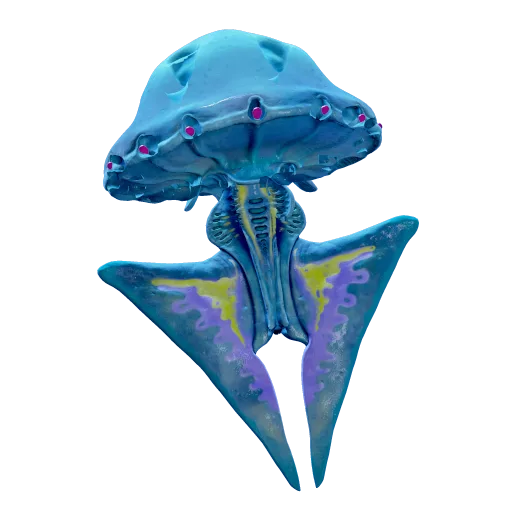
Surge jelly (tentatively Staurobrachia capacitor). Large, complex jelly that hunts with electric shocks.
Single animal
Unlike colonial organisms such as the Portuguese man'o'war, the surge jelly is a single animal with specialized tissues—far more specialized and complex than Earth jellies. Proposed class name: staurobrachia (pole arms).
Complex internal structure
Outer bell ringed with sense organs called rhopalia. A nerve net coordinates the bell's motions to swim and seek prey. The visible inner structure is the gut.
Feeding structure
The jelly retains its stalk — a remnant of its growth in a stack of clones. The stalk draws in nutrients for the gut.
Charged fins
Two rigid fins contain wirelike electrocytes, likely a development of ancestral tentacles. These organs build voltage to stun or kill prey. Measured power ranges from 400 to 1000 volts at 1 ampere: enough to kill a human.
Peculiar passengers
Traces of radioactivity, high-temperature waxes and sulfuric acid imply contact with a hydrothermal vent. Composition of the jelly's tissues suggest origins in the deep ocean.
Former domestics?
Jellies in close proximity communicate through their electric fields. Whether jellies have individual names or a grammatical language is purely speculative, but some patterns may be trained or learned—even passed down through generations of jellies.
Assessment
minor danger in close contact. Fascinating research prospect from a distance.

Encounter guide
- ›Will not attack unless provoked — safe to approach.
- ›Herbivore — only aggressive if cornered or provoked.
Where to find
2–112 m N 354° · 170 m from Lifepod
4–312 m E 89° · 1,550 m from Lifepod
210–290 m E 88° · 1,510 m from Lifepod
42–66 m N 358° · 70 m from Lifepod