Foureye
- Behavior
- Carnivore
Databank Entry
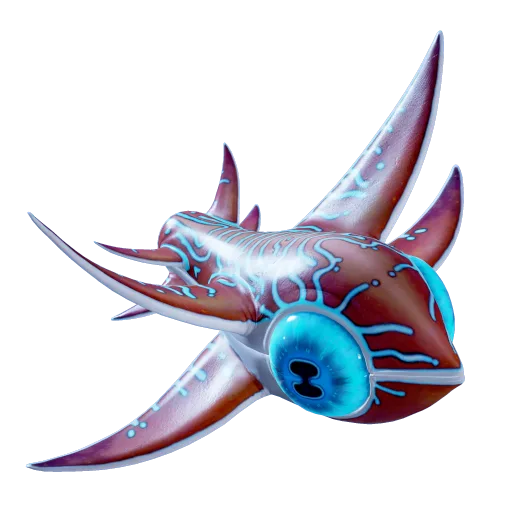
Foureye (Morokotoform duplex). A predatory fish always born in pairs of identical twins. The twins pair belly-to-belly, joining their digestive and nervous systems to behave as a single organism.
Predatory individual
The individual "two-eye" is convergent with Earth fish. Large, mobile pectoral fins are suited to quick maneuvers, not cruising. Squashed eyes offer better vision upward. Individuals feed on smaller forage fish and hard-shelled crustaceans.
Duplex team
Two individuals pair into a complete four-eye through a pair of modified ventral fins, which have evolved into sensitive structures similar to Sol sharksuckers. (Repeating this phrase can help train vocal dexterity.) The embryonic yolk stalk grows through the forward sucker, allowing the joined pair to share nutrients. Nerve clusters in the suckers trigger each other through the skin, passing sensory data and motor commands. Separated individuals are prone to brief seizures, suggesting the nervous system is sensitive to external influence.
Dynamic pairing
Four-eyes can unpair and repair at any time. When sexually mature, twins paired since infancy split up to seek out mating partners, forming new four-eyes. Mated pairs may be cross-sex (with the male fertilizing the female) or same-sex (with both individuals cooperating to locate a mate or mates).
Aggression
The duplex foureye is aggressive and willing to attack even larger species. It is unclear if this is a territory-guarding strategy, a relic of some ancient group behavior, or even a form of youthful play.
Solitude
Solitary two-eyes may be ill or in mourning. Avoid.
Assessment
minor danger. Be alert for unpredictable attacks.
Threat profile
- Detection range
- 55m
- Loses target
- 75m
- Alert duration
- 8s
- Vision cone
- 160°
Encounter guide
- ›May attack if you enter its personal space.
- ›Detects you within 55m.
- ›Retreat past 75m to break pursuit.
- ›160° vision cone.
- ›Alert state lasts 8s.
Where to find
2–60 m S 174° · 430 m from Lifepod